
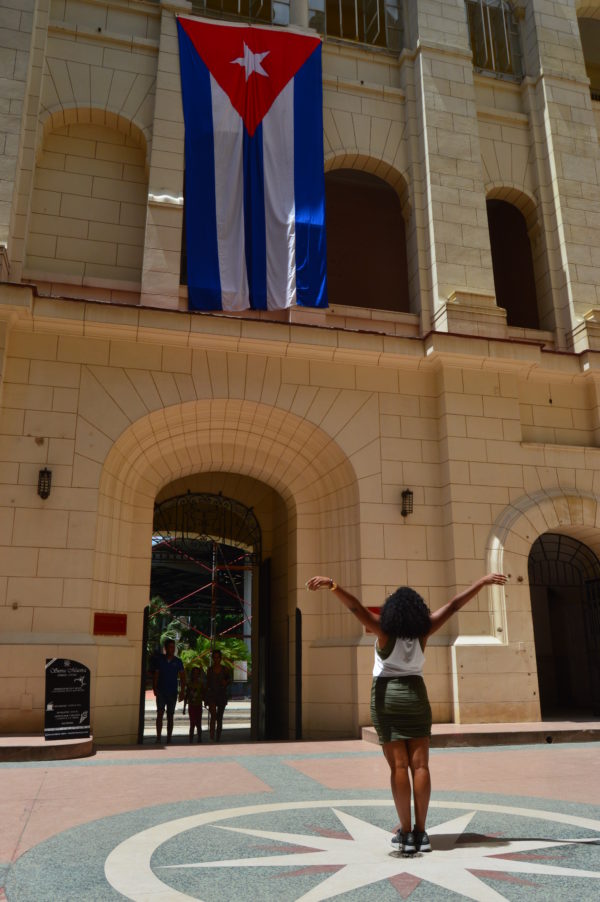
Doing Business in Cuba Under the Burden of the U.S. Embargo
Vanessa Cooksey & Kira Van Niel • August 1, 2016
MNGT 9950: Issues in Business: Entrepreneurship in Cuba
“If Cuba had a national word…that word would be ‘complicated,’” proclaimed Cuban tour guide Cynthia Bordon Garcia, as she concluded a week [July 17-23rd] with a group of Webster University graduate students. Exploring entrepreneurship in Cuba, the group visited more than 15 businesses and cultural institutions and heard from historians and tourism experts in their quest to understand the social and economic landscape in Cuba and possible entrepreneurial opportunities on the island.
A particularly historic time to visit the country that sits 90-miles south of Miami, Cuba and the United States are updating their political relationship status to “thawing” as July 20, 2016 marked the one-year anniversary of re-established diplomatic relations between the two countries. The beginnings of relationship building between the Obama and Castro administrations started as early as 2009 when the U.S. Treasury Department formally lifted nearly all U.S. restrictions on family travel to Cuba along with limits on how much money families can send to relatives on the island (DeYoung, 2009).
Greater progress was made on December 17, 2014 with the announcement of the beginning of a process of normalizing relations between Cuba and the U.S. aka the “Cuban Thaw” (Broder, 2014). Since then, Cuba has seen a marked increase in American tourists and business interest in the last year. According to the International Monetary Fund, an estimated 10 million American tourists will visit Cuba per year. Last year, Cuba hosted 700,000 U.S. tourists (Elliot, 2015).
Clearly stunted by the U.S. trade embargo established in 1959, Cuba’s communist government and economy is developing and has depended primarily on trade relationships with the top export destinations of China ($311M), the Netherlands ($157M), Spain ($141M), Senegal ($92M) and the United Kingdom ($67.3M) with exports like raw sugar, refined petroleum, rolled tobacco, hard liquor and raw nickel (OEC, n.d.).
While a majority of Cubans work for the state, an increasing number of workers are moving to the private sector. Restaurants and social enterprises are growing segments in Cuba as they allow greater opportunities for private ownership and cooperative economics that support the local community. With a solid social infrastructure in housing, healthcare and education, Cubans enjoy a 99% literacy rate and average life expectancy of 79 years (World Bank Group, 2016). Fiercely loyal to their diverse heritage and culture of self-determination, Cuba has a robust arts industry that includes fine art, music and dance.
Understanding Cuban culture and politics is critical when considering business opportunities in Cuba. A few points to consider:
There’s an African Proverb that says, “If you want to go fast, go alone…If you want to go far, go together.” This is sage advice for entrepreneurs looking to do business in Cuba. Whether the opportunity is a small business or expansion effort of a U.S.-based Fortune 500 company, joint-ventures and cultural immersion to gain greater understanding of the people and their needs provide the best opportunity for success.
References
Broder Jonathan. (17, December, 2014). How the U.S. and Cuba Ended Their Cold War. Newsweek Retrieved on July 26, 2016 from http://www.newsweek.com/exclusive-how-us-and-cuba-moved-past-decades-hostility-293075
DeYoung, Karen. (3, September, 2016). U.S. Removes Almost All Restrictions on Family Visits to Cuba. Washington Post. Retrieved on July 28, 2016 from http://www.washingtonpost.com/wp-dyn/content/article/2009/09/03/AR2009090303810.html
Elliot, Christoper. (14, August, 2016). What Americans should expect when traveling to Cuba. Fortune. Retrieved on July 28, 2016 from http://fortune.com/2015/08/14/cuba-travel-us/
Gouri, Shashank. (25, August 2015). “How Cuba’s reopening could change its energy future” GreenBiz. Retrieved on July 31, 2016 from https://www.greenbiz.com/article/how-cubas-reopening-could-change-its-energy-future
Gonzalez Alonso, Pablo and Lee, Alec (16, March, 2016). Harvard Business Review: The Potential and Pitfalls of Doing Business in Cuba. Retrieved on July 12, 2016 from https://hbr.org/2016/03/the-potential-and-pitfalls-of-doing-business-in-cuba
Investopedia. (2016). Definition of Joint Venture. Retrieved on July 31, 2016 from http://www.investopedia.com/terms/j/jointventure.asp
Malter, Jordan and Brooks, Abigail. (5, January, 2015). Did you know Cuba has two currencies? CNN Money. Retrieved on July 24, 2016 from http://money.cnn.com/video/news/2015/01/05/cuba-currencies.cnnmoney/index.html
Personal Conversation. Delgado, Alejandro. University of Havana. Occurred on July 20, 2016 during Webster University visit to Cuba.
Personal Conversation. Cliver, Bruce. Foreign Officer Spokesperson, Occurred on July 20, 2016 during Webster University visit to Cuba.
The Observatory of Economic Complexity (n.d.) Cuba. Retrieved on July 28, 2016 from http://atlas.media.mit.edu/en/profile/country/cub/
U.S. Embassy in Cuba. (26, July 2016). Spokesperson. Retrieved on July 28, 2016 from http://www.state.gov/r/pa/prs/ps/2016/07/260306.htm